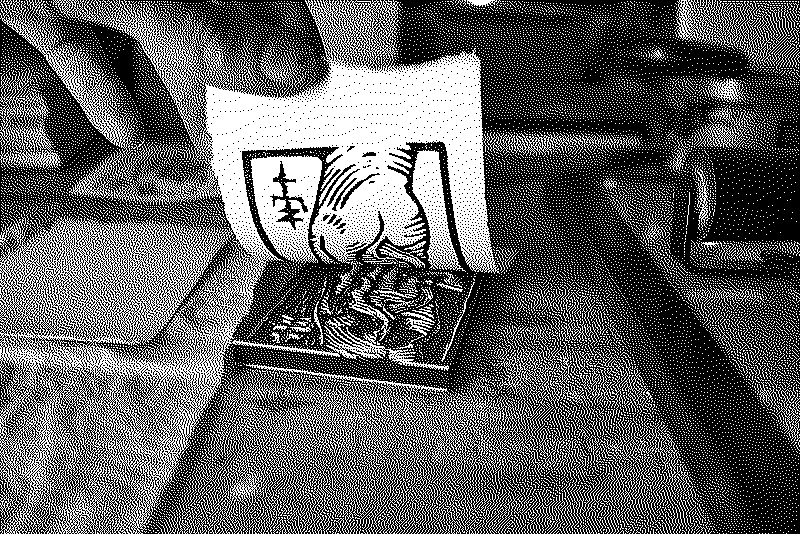
Mezzotint is a printing technique in the intaglio family (printing in which the ink is contained in the recesses of the printing plate, opposite of relief printing) in which a metal plate is textured with thousands of little dots and then scraped and burnished to create areas of light in the image. In contrast with other intaglo print techniques, the image is created from dark to light as the plate once prepared with it’s rough texture will print as a rich even black.
This technique originated in 1642 when german soldier and amateur artist Ludwig von Siegen created the first mezzotint print, a portait of Countess Amalie Elisabeth of Hanau-Münzenberg. The rocker (the tool used to create the fine texture on the plate) was then invented by Prince Rupert of the Rhine, which brought over the process to england where it was used quite extensively up until the 1930’s.
When I started delvng deeper in the world of print-making, mezzotint quickly became one of my favorite techniques because of how it could reproduce really deep and lush blacks and how subtle tones and shading could be achived. Part of me also really liked the exteremely meditative process of rocking copper plates, slowly creating this intricate texture with successives passes.
If you’re interested in other printmaking techniques, I’m also working on a page on relief printmaking .
Table of contents
Principle
Tools
Preparing the plate
Transferring the image
Burnishing the plate
Setting up registration
Preparing the paper
Printing the image
Drying the prints
References
The principle
Mezzotint works by first texturing a metal plate (usually copper or aluminium) with a tool called a rocker to allow ink to be trapped evenly in the thousand of small dots of the surface. Scapers and burnishers are then used to progressively remove the texture of the surface and polish the plate to a smooth finish in some areas where ink will be wiped away creating the appearance of light in the print.
The tools
Rockers are tools with hundreds of small teeth distributed along an edge wich is rocked back and forth on the plate following a pattern to create the initial texture.
A pole rocker or rocking jig can be attached to the rocker with 2 bolts through the plate and makes the process of rocking evenly easier as it keeps the angle of the rocker always the same and allows to apply preasure more easily. These can be easily made from from or metal parts.
Scrapers are sharp edged tools that allow to scrape material from the surface of the plate.
Burnishers are smooth metal tools that allow to polish the surface of the plate, flatenning the ridges formed by the rocker.
Tarlatan Open mesh fabric formed into a ball used to wipe the excess ink off the plate.
The carving process
Preparing the workspace
Since the plate gets very reflective when scraping and burnishing, it is best to have a soft diffuse light shining on it to see your work better. One way to achieve this is by making a frame with a diffusion material mounted to it and place a light behind it. The diffusion material can be tracing paper or the fabric diffuser material used in photography softboxes. The frame is then angled towards the plate to ensure a nice even light.
Preparing the plate
The first step in the making of a mezzotint print is preparing the metal plate. Before rocking the plate it is advised to knock down the corners and edges of the plate to prevent the teeth of the rocker breaking on them. The plate is then laid flat on a surface and taped in place to prevent it from moving around. Then the rocker is held on one hand, with its blade perpendicular to the plate’s surface and rocked back in forth while applying pressure to create the texture.
The amount of pressure, the placement of the arm and the subtle forward motion applied is best learned by practice, but generally a good amount of pressure is needed to create deep enough holes in the plate. The movement of the tool can be quite fast but has to be controlled in order to keep every row of dots as close as possible to the previous one for a nice even texture.
Tip: When using the rocker, try to avoid rocking it to its edges because those will dig deeper in the plate and make the texture uneven, aim for using 80-90% of the width of the rocker.
The rocking of the plate is usually done in passes in order to hide the tool marks in the final print. A good approach for these passes is to do one pass from every side of the plate and then one diagonal pass starting from every corner for a total of 8 passes. You can also do more passes and more directions if you see spots of smooth copper still present after those intial 8 passes.
Once the plate is rocked and the texture is even, the edges are filed at 45 or more degrees to prevent the paper being cut by the sharp corners of the plate during the printing process. These edges are then polished with fine sandpaper and polishing compound or using a burnisher so they can be wiped clean of ink before printing.
Transferring the image
Since the plate surface is very texture after its initial preparation, a good way to transfer the image of the print to the plate for scraping and burnising is to draw it on using a pencil. Carbon transfer paper also works well.
Burnishing the plate
This is the stage where the image is created on the plate, bringing lights to the shadows. This process takes a bit of getting used to because it works in opposite way as drawing where shadows are progressively added but since the plate areas that gets scraped and polished reflect more light you can get a bit of a preview of what the final image will look like.
Scraper are best used to bring back larger areas of white first and then the burnishers can be used to gently soften and polish textured areas to create an infinite amount of grey tones. When a first pass is done with these tools, it’s a good idea to print a test print to get see what the image looks like printed and then doing corrections and adding more light. It’s always easier to scrape and burnish some more in an area than having to rock an area again and go back to it with a scraper.
The printing process
Setting up registration
using a transparency
Preparing the paper
cutting the paper
wetting the paper
Printing the image
Applying the ink
remove the bulk of excess ink
polishing
cleaning the edges
printing
Drying the prints
Your prints will need to dry once printed, usually for a couple hours (especially if using oil-based ink).
In studios, drying racks are used for that purpose but you can also hang them on a clothesline, line them up on flat surfaces or tape them to a vertical board.
References
- The Mezzotint: History and Technique by Carol Wax
- How to make a mezzoting by Art Werger